Introduction
A mala is much more than a beautiful necklace with some mala beads. In this article you will learn what a mala really is, how a mala is constructed and the symbolism behind the sacred number 108. You will also discover which materials malas are made of and how different traditions — from Hinduism to Christianity and Islam — use their own form of prayer beads.
What is a mala?
The meaning of a mala
A mala (Sanskrit for ‘meditation garland’) was originally intended as a prayer necklace: a tool for counting mantras during meditation. Many people get distracted while meditating. A mala helps with this: after each mantra, your fingers move to the next bead, so you don’t have to count and can keep your attention on the mantra. The continuous repetition of a mantra is called ‘mantra japa’ — japa means ‘repetition’ in Sanskrit.
We find malas in various cultures and traditions. Catholics, for example, have a rosary; the purpose is the same: connection with the Divine. Malas are not only used as an anchor during spiritual practice, but also as a protective amulet — for example after they have been blessed or charged with a mantra.
The malas we offer are made of authentic Rudraksha mala beads and are traditionally used by Hindus and often by Buddhists. Rudrakshas are sacred in various cultures and are the oldest known prayer beads in the world. They are also called the tears (or eyes) of Shiva. Rudrakshas grow on the Elaeocarpus tree, inside a blue berry. Inside the berry is the Rudraksha, which contains seeds. The most common Rudraksha has 5 seeds and refers to Shiva.
Would you like to deepen your knowledge about Hinduism? Check this page and learn with multi examples about everything you always wanted to know (page is in Dutch).
The structure of a mala
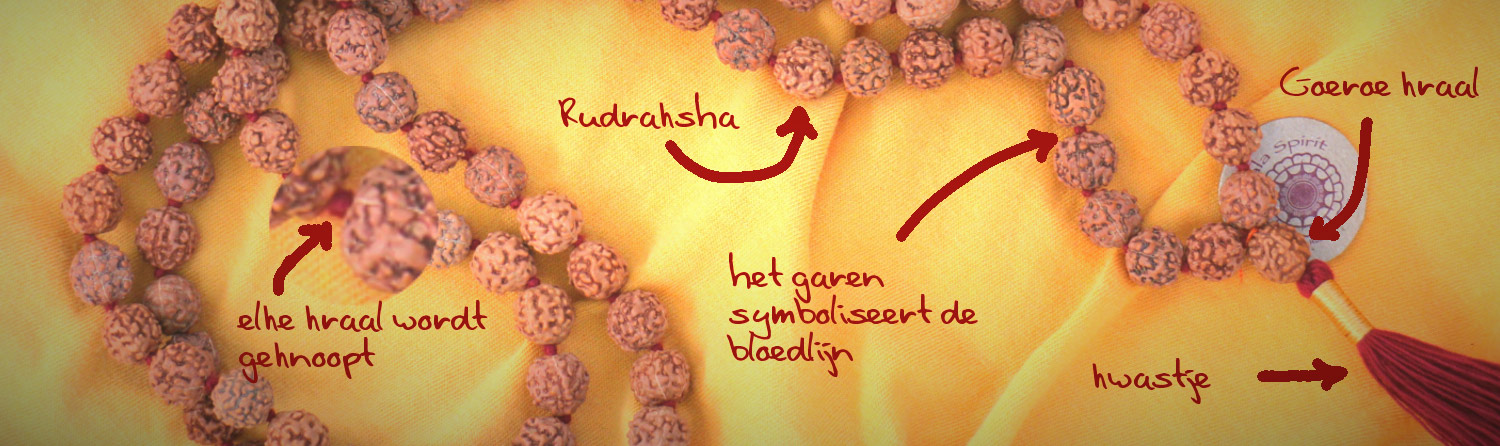
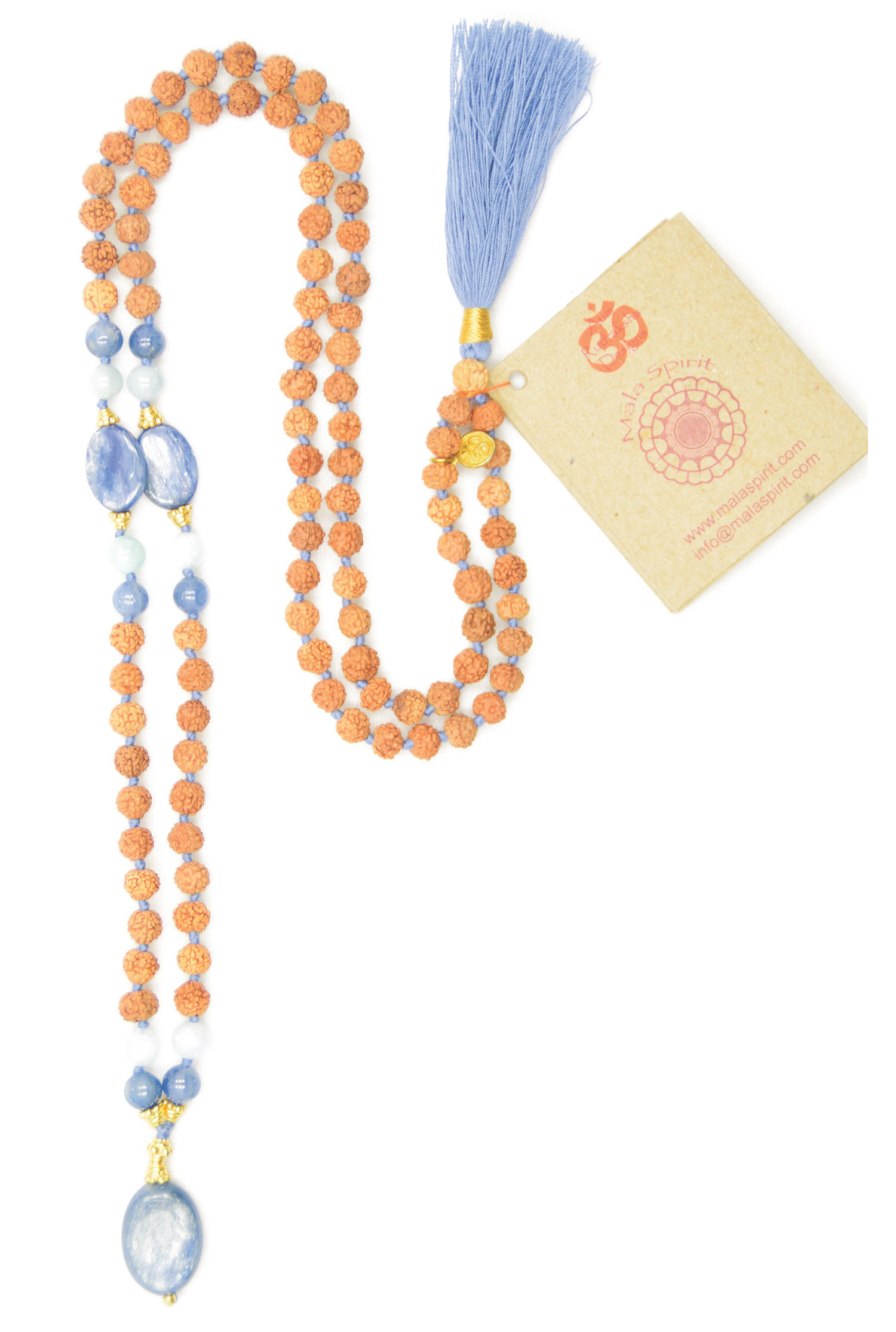
A mala usually consists of 108 mala beads + 1 guru bead and a tassel. There are also malas with, for example, 27 or 54 beads (always +1 guru bead) for shorter meditations, often seen as a mala bracelet. There are also malas of 162 beads. The starting point is always the number 108. Each part of the mala has its own meaning:
· The 108 mala beads represent the entire manifest universe in all its aspects. The mala beads form an unbroken circle: the symbol of the eternal, cyclical nature of existence, without beginning or end. The circle also stands for ‘samsara’ — the cycle of birth and death, also known as reincarnation.
· The guru bead (also called the Meru or Sumeru bead) is the bead that lies outside the circle of 108. This bead represents the Guru or Master who guides us to our true nature: the Supreme Consciousness, which lies beyond the manifest universe — changeless, without name or form.
· The tassel that follows the guru bead symbolises the fourth state, ‘Turiya’: the transcendental state beyond the three aspects of time (past, present, future) and the three states of consciousness (waking, dreaming, deep sleep). The tassel also drains negative energy. Other scriptures describe the tassel as a symbol of our pure and perfect state of total enlightenment.
· The string that runs through all the beads represents the Supreme Consciousness that is one with all aspects of existence — also called the bloodline of the mala.
· The knots between the beads symbolise the direct connection between all aspects of existence: the interconnectedness of all things. Practically, the knots keep the beads from touching each other, so that your mantra japa can take place with full concentration and awareness.
The ultimate goal is to recognise the ultimate truth of Reality, so that we can escape the cycle of birth and death and live in total bliss — merged with the Supreme Consciousness, which is absolute, unchanging, infinite and eternal.
The symbolism of the sacred number 108
The meaning and esoteric knowledge behind the number 108 are largely unknown and hidden. As complex as the universe, so mysterious are the connections surrounding this number. A few examples:
- · A Rudraksha mala has 108 mala beads plus one guru bead. The 108 beads symbolize the total nature of Reality; the guru bead (the 109th) sits outside the circle and represents that which lies beyond the manifest universe.
- · There are 108 Upanishads (sacred texts containing the highest teachings on reality). A list of these can be found in the Muktika Upanishad.
- · There are 27 significant stars (or star groups) — Nakshatras — that influence our perception. Each Nakshatra has 4 segments, each with its own energetic quality: 27 × 4 = 108.
- · There are 12 zodiac signs and 9 planets in Vedic astrology (Sun, Moon, Mars, Venus, Mercury, Jupiter, Saturn, Rahu and Ketu): 12 × 9 = 108. The number 108 thus represents the cosmic order of cause and effect — karma — in which the macrocosm (planets and stars) reflects the microcosm (our karma). What is within, is without.
- · The diameter of the sun × 108 ≈ the distance between the sun and the earth. The diameter of the sun is about 108 times greater than that of the earth. The diameter of the moon × 108 ≈ the distance between the earth and the moon.
- · 1 + 0 + 8 = 9. The number 9 is symbolically connected with the Divine Mother as Creator (also related to Brahma as the Creator).
- · The Shri Yantra is defined by 108 points (‘marmas’), where three lines intersect: 54 intersections, each with a masculine (Shiva) and feminine (Shakti) aspect: 54 × 2 = 108.
- · Our subtle energy body has 108 marma points: places where energy pathways meet or intersect. Some sacred texts speak of 107 marma points in the body, with the 108th point being the mind. Of the 108, 12 are of vital importance; the remaining 96 have a supporting function.
- · In the brain there are 108 sensitive nerve centres that correspond to 108 subtle chakras or energy points.
- · The heart chakra, at the centre of the chest, is said to be formed by 108 converging energy lines (nadis). One of these, the sushumna nadi, leads to the crown chakra and is the path to self-realisation.
- · The Sanskrit alphabet has 54 letters, each with a masculine (Shiva) and feminine (Shakti) aspect: 54 × 2 = 108. This is one way of classifying the alphabet; there are others.
- · In the Buddhist tradition there are said to be 108 desires, 108 forms of ignorance and 108 lies of humankind.
This is not a complete list, but these examples give a good impression of the special role of the number 108.
What materials are malas made of?
Malas beads can be made of various materials; the choice often depends on the tradition. Commonly used materials are: Rudraksha beads, sandalwood, tulsi, precious and semi-precious stones, rosewood, lotus seeds, coral, glass, metals, shell, bone and vegetable seeds.
Malas that incorporate gemstones also have supportive (healing) properties. These properties are closely related to the conditions under which a stone (mineral) was formed. Look here for an explanation of the gemstones and discover whether there is a mala that can support you. Which mala you choose depends on your intention and desire. Are you ready? You will find all our malas here.
Good to know about Rudrakshas: twice a year the trees bear the fruits in which the Rudrakshas grow — a guarantee of a good supply, although the trees only grow in Southeast Asia. So no trees need to be cut down to make malas. And even if you don’t use a mala to count mantras: Rudrakshas are a powerful conductor of energy that can support you in a completely different way during your meditation.
Malas in various traditions
Hinduism
Hindus use the mala necklace for reciting mantras or the name of the Deity, during meditation, during pujas and homas (sacred ceremonies) and also as a protective, blessed object. The mala is often called a ‘japa mala’. The use of prayer beads in Hinduism can be traced back to the earliest texts of the Vedas.
- Within the Hindu traditions, the materials differ per lineage:
- · Devotees of Vishnu, Rama or Krishna usually wear tulsi malas.
- · Devotees of the Divine Mother — Saraswati and Lakshmi in particular — often wear crystal quartz malas; devotees of Lakshmi also wear lotus seed malas.
- · Devotees of Hanuman or Ganesha often wear a coral mala.
- · The nine planets of Vedic astrology each have their own precious and semi-precious stones corresponding to their energies.
- · Devotees of Shiva and Shakti mostly wear Rudraksha malas.
Jainism
The Jains use a mala with 108 beads, usually made of sandalwood seeds, precious stones, gold or silver, marble, vegetable seeds or thread. In Jainism, the number 108 corresponds to the combined virtues of the five categories of holy ones (the Pancha Parameshti, the Supreme Five): Arhats, Siddhas (liberated souls), Acharyas (spiritual leaders), Upadhyayas (preceptors of less advanced ascetics) and Sadhus (monks or sages). The number 108 also represents the number of ways in which one can incur karma: 4 Kashays (anger, pride, arrogance, greed) × 3 Karanas (thought, speech, bodily action) × 3 stages of planning × 3 ways of execution = 108.
Buddhism
In Buddhism the mala is known as, among other names, ‘Su-Chu’ (Chinese), ‘Juzu’ (Japanese) or ‘Seik badi’ (Theravada, Myanmar). A Buddhist mala usually has 108 beads or a fraction thereof (54 or 27), made of, for example, Rudraksha, tulsi, bodhi or lotus seeds, sandalwood, pearls, precious or semi-precious stones, wood, glass or bone.
The mala is used for mantra recitation, counting one’s breath during meditation, counting prostrations or repeating a buddha’s name. The number 108 symbolises the worldly desires that a person must overcome to reach nirvana: 6 senses × 3 aspects of time × 2 conditions of the heart (pure or impure) × 3 possibilities of sentiment (attraction, aversion, indifference) = 108. It is also said that the footprint of the Buddha contains 108 auspicious symbols, and that the number refers to the 108 Arhats (holy ones). The mala is also seen as a symbol of Avalokiteshvara — the bodhisattva who embodies the compassion of all the buddhas.
Sikhism
In Sikhism the mala is called ‘Simarni’ and has 108 beads. It is used for mantra japa, for the repetition of the Guru Mantar ‘Waheguru’ and for the recitation of the holy scriptures (Guru Granth Sahib). The number 108 is said to refer to the 108 quotes of the Guru in the Guru Granth Sahib. This mala is also made of materials such as Rudraksha, sandalwood and precious and semi-precious stones. Sikhs wear their mala around the neck, in the turban or around the wrist.
Christianity
In Christianity the mala is called a rosary: a ‘garland of roses’. The rose is a symbol of perfection; a garland of roses represents how a perfect prayer can reach the heart of the Lord. The first rosaries were made from the stem of the rose plant, and Mother Mary was fond of roses — hence the name.
The beads of a rosary can be made of a wide range of materials: silver, gold, crystal, precious and semi-precious stones, glass, wood, bone, pressed flowers and seeds such as the rosary pea. A rosary consists of 54 beads in a closed circle, followed by a ‘tassel’ of a cross or crucifix, one large bead, three small beads and one more large bead — five beads in addition to the cross, which is why some describe a rosary as having 59 beads in total. The structure:
· 5 sets of 10 small beads (decades) represent the Mysteries associated with the lives of Mary and Jesus. With each bead, a ‘Hail Mary’ is often prayed.
· 4 larger beads separate the decades; here the ‘Our Father’ is prayed. They are associated with the Joyful, Glorious and Luminous Mysteries.
· The cross stands for faith in God and the remembrance of the suffering of Jesus; here the Apostles’ Creed is often prayed.
· The first large bead represents God; here the Our Father is prayed.
· The three small beads stand for the three theological virtues: faith, hope and charity. These correspond to the three forms of energy in the Vedic tradition: knowledge (Jnana Shakti), will (Iccha Shakti) and action (Kriya Shakti). Here the Hail Mary is often prayed.
· The second large bead commemorates the mission of the Lord; here the ‘Glory Be’ is often prayed.
There is a beautiful parallel with the Vedic mala: it usually has 108 or 54 beads in a circle, with an additional bead or beads as the guru bead within its tassel. In the rosary there are, as it were, five ‘guru beads’, and the cross replaces the tassel. The tassel of a Vedic mala represents the lotus — a symbol of purity and perfection — just as the cross represents the purity and perfection in the life of Jesus.
Islam
Muslims call their mala ‘Misbaha’, ‘Tasbih’ or ‘Tespih’; it has 33 or 99 beads, corresponding to the 99 names of Allah. With 33 beads, the mala is cycled through three times. The Misbaha is used throughout the Muslim world, by Sufis and non-Sufis alike. Traditionally it is used to recite the ‘Tasbih of Fatimah’ — a prayer said to have been given by Muhammad to his daughter as a gift: chanting ‘Subhan Allah’ (Glory be to God) 33 times, ‘Al-hamdu lillah’ (Praise be to God) 33 times and ‘Allahu Akbar’ (God is the greatest) 33 times = 99 prayers. Beads from Mecca are considered the most sacred, but the beads can also be made of wood, marble, ivory, seashells, horn, pearls, amber or plastic.
In closing
Whether you meditate with mantras or wear a mala as a personal symbol of connection and protection: there is always a mala that suits you. Look here for an explanation of the gemstones or view all our malas here.
Would you rather wear a mala on your wrist? Then here are our mala bracelets.